How To Mix Peptide With Bac Water How much bacteriostatic water to mix with 30mg peptide?
\nHow Much Bacteriostatic Water to Mix with 30mg Peptide? A No-Nonsense Guide
\n\nIf you have been browsing fitness forums, longevity subreddits, or biohacking spaces recently, you have likely noticed an explosion of interest in research peptides. Whether it is for tissue repair, metabolic optimization, or muscle recovery, more young men aged 18-24 are taking an interest in these compounds. However, ordering a vial is only the first step. The moment that small glass bottle of freeze-dried powder arrives, you face a critical question: how much bacteriostatic water to mix with 30mg peptide vials to ensure accurate and safe dosing?
\n \nGetting the fluid volume wrong does not just mess up your math; it can lead to accidental overdosing, wasted product, or severe localized irritation. This guide cuts through the online noise to deliver an objective, consumer-first breakdown of peptide reconstitution math, real-world practicalities, and quality metrics you need to know before conducting any laboratory research.
\n\n\n\n
What How Much Bacteriostatic Water to Mix with 30mg Peptide Is and Who It Might Fit Best
\n \nThe phrase "how much bacteriostatic water to mix with 30mg peptide" represents the foundational math problem of peptide research. Peptides typically ship as a lyophilized (freeze-dried) cake or powder. This state keeps the delicate amino acid chains stable during transit. To use them, you must introduce bacteriostatic water—sterile water containing 0.9% benzyl alcohol, which acts as a preservative to inhibit bacterial growth.
\n \nThis specific topic is highly relevant for independent researchers, fitness enthusiasts, and biohackers looking to optimize their physical recovery or cognitive performance. A 30mg vial is a relatively large quantity for many common peptides, meaning that a minor mathematical error during reconstitution will amplify across dozens of planned doses. It fits best for those who possess a meticulous mindset, access to sterile laboratory supplies (like U-100 syringes), and the patience to double-check their calculations before proceeding.
\n\n\n\n
Practical Benefits and Where It Falls Short
\n \nUnderstanding the proper fluid ratios offers several practical benefits. First, it ensures dosing precision. For example, if you dilute a 30mg vial with 3mL of bacteriostatic water, you establish a clean ratio of 10mg of peptide per 1mL of liquid. On a standard 100-unit (1mL) insulin syringe, every 10 units will equal exactly 1mg of your compound. This makes measuring out smaller micro-doses incredibly straightforward and reduces cognitive error.
\n \nHowever, where this process falls short is its steep learning curve and the margin for human error. If you decide to use too little water, say 1mL, the solution becomes highly concentrated, making it exceptionally difficult to pull a precise micro-dose without overshooting. Conversely, adding too much water means you have to inject a larger volume of fluid, which can increase localized swelling and discomfort at the injection site.
\n\n\n\n\nPersonal Experience Case (Success): A 22-year-old weightlifter purchased a 30mg vial of a recovery peptide. By calculating that mixing 3mL of bacteriostatic water would yield 1mg per 10 units, he comfortably drew a 500mcg (5 units) daily dose for a 60-day research period. The math remained simple, the injections were small and painless, and the compound remained stable in the refrigerator throughout the cycle.
\n
\n\n\nNegative Case (Failure): A college student attempting the same protocol rushed the process and mixed only 1mL of bacteriostatic water into his 30mg vial. Because the fluid was so concentrated, a single tick-mark error on his syringe resulted in him taking three times his intended dose. He experienced severe lethargy, rapid heart rate, and painful site irritation that forced him to discard the remaining $120 vial entirely.
\n
 \n
\n \n\n
What Research Suggests and What It Doesn\'t
\n \nCurrent clinical research regarding peptides is a mixed bag. While certain compounds show immense promise in animal models for accelerating tendon healing or upregulating growth hormones, human data remains strictly limited. Many of these substances are classified as "research chemicals," meaning they have not received widespread FDA clearance for general consumer use.
\n \nScience emphasizes that the stability of a reconstructed peptide is fragile. Once bacteriostatic water is added, the chemical bonds begin a countdown toward degradation. Studies show that exposure to direct sunlight, vigorous shaking, or room-temperature environments can rapidly denature the protein structure, rendering your 30mg vial useless. What the research explicitly does not guarantee is uniform efficacy; individual genetics, lifestyle, and underlying health play massive roles in how a body responds, and potential side effects—ranging from insulin resistance to pituitary fatigue—are real risks that must not be minimized.
\n\n\n\n
Ingredients, Formats, and Quality Signals
\n \nWhen buying these products, you are looking at two distinct components: the peptide vial and the reconstitution liquid. The peptide vial should contain nothing but pure lyophilized peptide powder, sometimes paired with a tiny amount of mannitol (a bulking agent used to stabilize the cake during freeze-drying). The bacteriostatic water must strictly contain 0.9% benzyl alcohol; standard sterile saline or distilled water will allow bacteria to breed within days, ruining your compound.
\n \nTo ensure you aren\'t buying bunk or dangerous materials, you must look for specific quality signals. A reputable vendor will always provide a visible, batch-specific Certificate of Analysis (CoA) from an independent, third-party US laboratory. This report verifies the compound\'s identity and confirms a purity rating of 98% or higher. Avoid vendors that only display outdated or pixelated CoAs, or those that blur out the testing laboratory\'s name.
\n\n\n\n
Comparison of Common Options
\n \nWhen approaching your reconstitution setup, the amount of fluid you choose fundamentally alters your daily laboratory workflow. Below is a breakdown of how different mixing volumes change the handling of a standard 30mg peptide vial.
\n\n| Format (Fluid Volume) | \nTypical Dose/Use | \nPros | \nCons | \nCost | \nBest For | \n
|---|---|---|---|---|---|
| 1 mL Dilution | \nHigh concentration (3mg per 0.1mL) | \nVery small injection volume; less site wetness. | \nExtremely hard to measure micro-doses; high risk of math error. | \nLow ($2-$3 per vial) | \nAdvanced users utilizing high daily doses. | \n
| 2 mL Dilution | \nModerate concentration (1.5mg per 0.1mL) | \nFits easily in standard small vials; decent balance. | \nMath results in repeating decimals for certain micro-doses. | \nLow ($2-$3 per vial) | \nIntermediate researchers comfortable with syringe math. | \n
| 3 mL Dilution | \nStandard concentration (1mg per 0.1mL) | \nThe easiest math available; 1 tick mark is highly predictable. | \nRequires a larger volume injection if high doses are needed. | \nLow ($3-$4 per vial) | \nBeginners wanting to avoid dosing errors. | \n
| 5 mL Dilution | \nLow concentration (0.6mg per 0.1mL) | \nIncredibly forgiving if you accidentally pull an extra unit. | \nMay not physically fit into smaller 2ml/3ml manufactured vials. | \nLow ($4-$5 per vial) | \nUltra-low micro-dosing protocols. | \n
| Pre-mixed Solutions | \nVaries by manufacturer | \nNo manual reconstitution required; convenient. | \nDegrades rapidly during transit; no quality control over water source. | \nHigh ($20+ premium) | \nNot recommended due to degradation risks. | \n
\n\n
Buying Framework and Red Flags
\n \nNavigating the online marketplace for peptides feels like the Wild West. To protect your wallet and your health, use this strict checklist before hitting "buy":
\n \n- \n
- Verify the Domain Age: Check if the vendor\'s website has been active for at least a couple of years. Pop-up shops often sell unverified batches and vanish overnight. \n
- Look for Cryptographic Verification: Premium vendors use scannable QR codes on their vials that link directly to a live, verifiably unique testing report. \n
- Analyze the Price: If a 30mg vial of a complex peptide is listed for $30 while every other market competitor sells it for $110, it is either vastly underdosed, degraded, or completely fake. \n
- Inspect the Payment Methods: Be cautious of sites that only accept untraceable payment formats without any secure checkout alternatives. \n
 \n
\n \n\n
Common Mistakes and How to Avoid Them
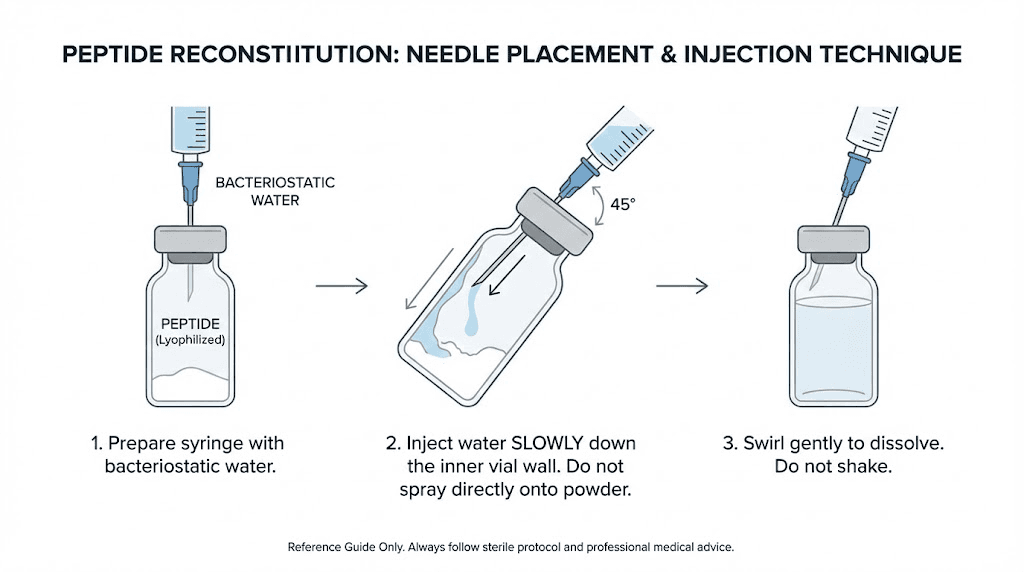
\n \nThe single biggest mistake researchers make when calculating how much bacteriostatic water to mix with 30mg peptide is squirting the liquid directly onto the lyophilized powder. The force of the water stream can shatter the delicate peptide chains, instantly rendering the batch less effective. Instead, always aim the needle at the glass wall of the vial, letting the bacteriostatic water slowly trickle down into the powder naturally.
\n \nAnother common blunder is aggressively shaking the vial to dissolve the powder. Peptides are not pre-workout powders. You must gently swirl the vial in circular motions or let it sit undisturbed in the refrigerator for 10 to 15 minutes until the liquid becomes perfectly crystal clear. If the fluid remains cloudy after sitting, it indicates either a contaminated batch or an incomplete dissolution process; do not use it.
\n\n\n\n
FAQ: Essential Reconstitution & Safety Questions
\n \nIs it proven that changing water volume alters peptide efficacy?
\nNo, the absolute volume of bacteriostatic water does not change the structural efficacy of the underlying compound, provided the entire amount is consumed over time. However, it alters the concentration density, which directly impacts your ability to measure doses accurately. Incorrect concentrations lead to human error, which directly degrades the real-world efficacy of your research protocol.
\n \nHow long does it take for a reconstituted 30mg peptide to degrade?
\nOnce mixed with bacteriostatic water, most peptides retain their structural integrity for roughly 3 to 4 weeks when stored constantly in a dark refrigerator between 36°F and 46°F. Beyond 30 days, the benzyl alcohol preservative remains effective at halting bacterial growth, but the peptide bonds themselves begin to break down, steadily reducing the potency of your remaining doses.
\n \nWhat are the primary side effects of improper dilution?
\nIf you mix too little water, the hyper-concentrated solution can cause severe localized side effects including redness, hives, burning sensations, and hard subcutaneous lumps at the injection spot. Conversely, over-diluting means injecting a large volume of cold fluid, which can cause local tissue bruising and prolonged soreness.
\n \nCan it combine with other peptides in the same syringe?
\nWhile some seasoned researchers draw two different reconstituted peptides into a single syringe immediately before administration to reduce the number of skin punctures, you should never mix two different dry peptides into the same vial with bacteriostatic water. Combining them long-term causes cross-reactivity, altering the chemical properties of both compounds.
\n \nIs an oral vs injection/alternative approach viable for a 30mg vial?
\nWhen analyzing oral vs injection/alternative routes, the vast majority of peptides possess incredibly poor oral bioavailability because stomach acids and digestive enzymes break down the amino acid chains before they reach the bloodstream. A 30mg lyophilized vial is explicitly manufactured for liquid reconstitution and injection; attempting to ingest it orally is an expensive waste of product.
\n\n\n\n
A Practical 2-Week Experiment Framework
\n \nIf you are testing a new batch or trying out a specific peptide calculation for the first time, running a conservative 2-week baseline trial helps monitor compound stability and personal tolerance. Here is an example layout using a 3mL dilution plan for a 30mg vial:
\n \n- \n
- Day 1 (Preparation): Carefully introduce 3mL of bacteriostatic water into your 30mg vial by letting it slide down the glass wall. Swirl smoothly and place in the fridge. Prepare a sanitary storage case away from light exposure. \n
- Days 2 to 4 (Tolerance Baseline): Draw a minimal dose (e.g., 2.5 units on a U-100 syringe, representing 250mcg). Administer at the same time daily. Monitor for acute side effects like facial flushing, lethargy, or immediate skin rashes. \n
- Days 5 to 9 (Consistency Evaluation): If no adverse reactions manifest, maintain your planned target research dose. Track localized site recovery. Note any changes in sleep patterns, joint comfort, or hunger levels, depending on the compound\'s profile. \n
- Days 10 to 14 (Stability Review): Inspect the vial clarity under a flashlight. Check for any signs of cloudiness or precipitate formation. Evaluate if the compound\'s subjective effects feel consistent with Day 2, confirming proper storage and mixing success. \n
\n\n
About the Author
\n \nMarcus Vance is a veteran independent research chemical analyst and content editor specializing in performance optimization tech and biohacking subcultures. Over the past six years, Marcus has personally audited and reviewed over 40 online peptide suppliers, focusing strictly on third-party verification transparency and chemical fluid dynamics math. He does not accept corporate sponsorships from peptide manufacturers.
\n \nDisclaimer: This article is intended strictly for educational and informational purposes. Peptides are largely classified as research chemicals and are not approved for human consumption by the FDA or international regulatory bodies. The calculations provided here are for laboratory research context only. Consult with a certified medical professional before starting any medical or chemical protocol.
\n
Discussion